Look for him; he'll be there: Talkin' WOODY GUTHRIE AND THE GHOST OF TOM JOAD TODAY w/ Greg Mitchell


July 14, 2026
There's no better way to celebrate today's 114th anniversary of the birth of the late, great, and artistically immortal Woody Guthrie than to watch Greg Mitchell's recently released film Woody Guthrie and the Ghost of Tom Joad Today. Mitchell has crafted a beautiful, moving, enlightening, and timely one-hour film about how Guthrie's path came to cross that of writer John Steinbeck, author of The Grapes of Wrath, and the enduring significance of their intersection.
Mitchell's film also begins and ends with edited, authorized versions of Bruce Springsteen singing his song "The Ghost of Tom Joad." A brief performance snippet of the song plays over the title card and a longer, less edited version (omitting only the second verse) of the 1995 Joad album's title track closes the film powerfully, combined with a set of images that deeply connects the past to the present, just as Springsteen's song does.
For the past few weeks, PBS stations around the U.S. have begun broadcasting Woody Guthrie and the Ghost of Tom Joad Today, and it's currently available to stream by clicking here or here.

Letters To You editor/publisher Shawn Poole recently conducted an interview with Greg Mitchell about his newest film, with a special focus on how Bruce Springsteen and his music came to be involved in it. Mitchell also detailed his long friendship with Springsteen, which has roots dating all the way back to 1972, shortly after Mitchell, then editing a revived version of the groundbreaking rock music magazine Crawdaddy, published a report that Columbia Records had signed a new artist named "Bruce Springstein" [sic.]
Check out Poole's interview with Mitchell below...
SHAWN POOLE: For many Springsteen fans - myself included - Woody Guthrie and the Ghost of Tom Joad Today feels right on time. Bruce’s song "The Ghost of Tom Joad" was regularly performed as a duet with Tom Morello at each show on Springsteen’s recent Land Of Hope & Dreams American Tour (which also used "This Land Is Your Land" as its nightly post-concert exit music,) and Woody Guthrie was a big part of the recent Music America: The Songs That Shaped Us concerts at Monmouth University (featuring Bruce and your film’s narrator Rosanne Cash performing Guthrie’s "Deportee" together.)
Those concerts marked the opening of the new Springsteen Center for American Music, where both Woody Guthrie’s and John Steinbeck’s work are prominently featured in several of the Center’s exhibits. Am I correct in presuming that you had little to no advance knowledge that any of this would be occurring just as your film would be released?
GREG MITCHELL: You are right; I had no inkling at all. However, I knew of Bruce’s past association and love for Woody, though did not know he won the Woody Guthrie Prize in 2021. Unlike many, I was a huge fan of The Ghost of Tom Joad album cut from the start, and the last time I actually talked to him was back around 1997 backstage at the Beacon in New York, where he performed it on that tour. I also loved the electric version with Tom Morello and posted the live video from the Rock and Roll Hall of Fame concert numerous times on my various blogs, Facebook, and my current popular Substack newsletter, Between Rock and a Hard Place.
So I was ultra-familiar with the song but not with most of the Grapes of Wrath connections with my longtime hero, Woody Guthrie. And it also became clear that Bruce’s song owed as much to Guthrie as to Steinbeck.
When I was making the film, however, Bruce was not so much in the public eye, so I had no inkling of a more dramatic tie-in. but of course that all changed with the Minneapolis tragedy and his response to it, leading to the big tour and "Ghost..." as one of the highlights every night. Then, as you mention, his "This Land Is Your Land" at the June concert, but naturally I vividly recall him singing it with Pete Seeger on the steps of the Lincoln Memorial for Obama’s pre-Inaugural concert, and many other times.
POOLE: What exactly led you to make this your next film after your four recent ones, also made for PBS?
MITCHELL: This film owes its start just one year ago when, I admit, I finally read the Steinbeck novel and it exceeded all of my somewhat jaded expectations. Then I found the many connections between the author and Woody at that time, most of them little-known, beyond Guthrie’s epic song, "The Ballad of Tom Joad."
This new fervor for Woody was propelled by the rise of anti-ICE and anti-Trump protests where the two leading crowd anthems seemed to be "This Land..." and "All You Fascists Bound to Lose." So Woody was becoming ever more popular and important, including with younger folks. I was also getting absorbed with writing about another Woody song vital to this moment: "Deportee," one of the great creations of the past century, and I wrote a widely-shared piece on the true incident behind it, the 1948 plane crash in California. Many were starting to sing or record that song as well, including Rosanne Cash, a friend going back a couple of decades. She did it for the first time in a concert I attended, which stuck with me when thinking about a narrator. By the way, Bruce sang both "Deportee" and "Tom Joad" when he accepted his Guthrie Prize.
So all of this, surrounding Woody's music and today’s politics, led me to make this film and get it completed and airing/streaming very quickly.
POOLE: I have a friend who’s a filmmaker, with extensive experience in licensing music for his films, including Springsteen music. It’s my understanding that Bruce’s 2021 sale of his music rights to Sony was very much a game-changer for the process of licensing of his music, too. What was that licensing process like for you with Woody Guthrie and the Ghost of Tom Joad?
MITCHELL: Yes, it would have been easier if Sony did not own the publishing and recorded music now, but... Bruce and Jon Landau made sure the negotiations were, let us say, based on a deep "friends and family" discount.
POOLE: Have you gotten to share your film with Bruce yet? If so, what did he think?
MITCHELL: I made sure that Bruce and Landau saw my early cut of those final minutes. I was pretty confident in how the lyrics and emotion of his singing fit the two dozen images and footage that I chose for it that help bring the Steinbeck and Guthrie messages up to date for 2026. They loved my handling of it and, as I said, made it possible to use the song at considerable length in the film.
And, as it turns out, it has moved audiences enormously, in some cases almost to tears, and is absolutely crucial to the film. The other fifty-four minutes, of course, are very relevant as they echo in today’s issues and struggles, but Bruce’s song and the images with it are really necessary in making that quite moving and explicit. It’s a much lesser film without that. So I am deeply in debt.
I sent the PBS link to the entire film to Bruce via Jon, just a couple of days ago.
POOLE: Bruce is among the folks thanked in your film’s credits for "Woody inspiration over the years." Can you tell our readers a bit more about your friendship with Bruce through the decades?
MITCHELL: In a nutshell... In 1971, I revived the legendary Crawdaddy, then served as its #2 editor eventually, under my good friend Peter Knobler starting the following year, and continuing almost non-stop until the magazine folded in 1979. In my usual column of short takes in 1972, I would note that Columbia had signed a certain "Bruce Springstein." I got a fateful call from Bruce’s fast-talking manager Mike Appel in early December 1972, announcing that he would be leading a big press caravan up to Sing Sing Prison for a concert for the cons by this still unknown singer. I said yes but I don’t know if it was mainly just for a chance to see the "Big House" for the first time. It was more than a month before the release of Greetings From Asbury Park, NJ.
I told Peter about it and he joined in. Bruce was then being hyped as yet another "New Dylan" and we were always a sucker for that. We arrived the morning of December 7, my birthday, to find we were the only two journalists of the dozens invited to show up for the trip. We found Bruce and band members to be tremendously fun and appealing (Bruce in his early trademark hoodie) though, as I have written, we didn’t get much of sense of Bruce’s original music that afternoon. After his first white-boy song fell flat with the inmates, Clarence stepped in with a sax solo which began a very long version of Buddy Miles’ soul classic "Them Changes." That was it for Bruce originals.
However, he was then in the middle of a few nights at the tiny folk club Kenny’s Castaways, then on the Upper East Side in Manhattan, and we rushed there that very night. I felt better when we found his name again spelled "Springstein" on the sign outside. There were maybe twelve people sitting at tables inside. He played the first few songs solo (including "Song For Orphans," "Vibes Man," maybe "Mary Queen of Arkansas" or "The Angel," and finally "Circus Song" with Danny on accordion and Garry with a tuba.) Then he said, "Let’s bring up the band." And we were really blown away (e.g. "Lost in the Flood" and "Spirit in the Night" and the set closed with "Thundercrack," I believe.)
Needless to say, we stayed for the second set, and then came back the following night. We got test pressings of Greetings... from Appel and decided (pre-dating Landau) that Bruce was indeed the future of rock ‘n roll. Peter then wrote, and I contributed to and edited, an unprecedented 6000-word feature piece on a total unknown.
As it turned out, the album (and our article) received a lukewarm reception but we kept showing up at Bruce concerts, usually as the only media anywhere nearby, and always greeted warmly backstage and even with song dedications. Bruce would stop by our office whenever in town and we’d hang out with him in Jersey, at the little house in Bradley Beach and bumming around the shore. I rode, with him driving (without a license, I later learned) to a gig in my hometown of Niagara Falls. He let me stay in his house for two weeks to work on a novel after he moved to Atlantic Highlands.

Crawdaddy published the first national cover story on Bruce two months before the famous Time and Newsweek issues. Our Crawdaddy team swept the E Streeters in a softball doubleheader in Jersey in 1977. I’ll leave it at that.
But after “Born to Run” took off he had wisely closed himself off to most “outsiders,” and I talked with him much less often after, and then not at all, until that night at the Beacon. Then, a few years later, around 2008, he contributed the preface to my book about how the media mishandled Bush’s invasion of Iraq and its aftermath (one of my fourteen books, So Wrong for So Long.) I remained in touch with and on friendly terms with Landau, who forwarded some of my pieces and recent films to Bruce. So I felt it was natural to ask (without much confidence) to be able to use “Ghost...” as a crucial part of my film—just days before, as it happens, Bruce recorded “Streets of Minneapolis” and began performing the song again on the tour. Happily, they accepted.
POOLE: Incidentally, I didn’t catch a name in the credits for the actor in Woody Guthrie and the Ghost of Tom Joad Today providing the voice of John Steinbeck when needed. Who was that?
MITCHELL: That would be me... The Ghost of John Steinbeck.
----------
Click here to stream Woody Guthrie and the Ghost of Tom Joad Today via the PBS website, and/or find out when you can watch it on your local PBS station(s.)
Click here to stream and read more about Woody Guthrie and the Ghost of Tom Joad Today via Greg Mitchell's Exposed Films' website.
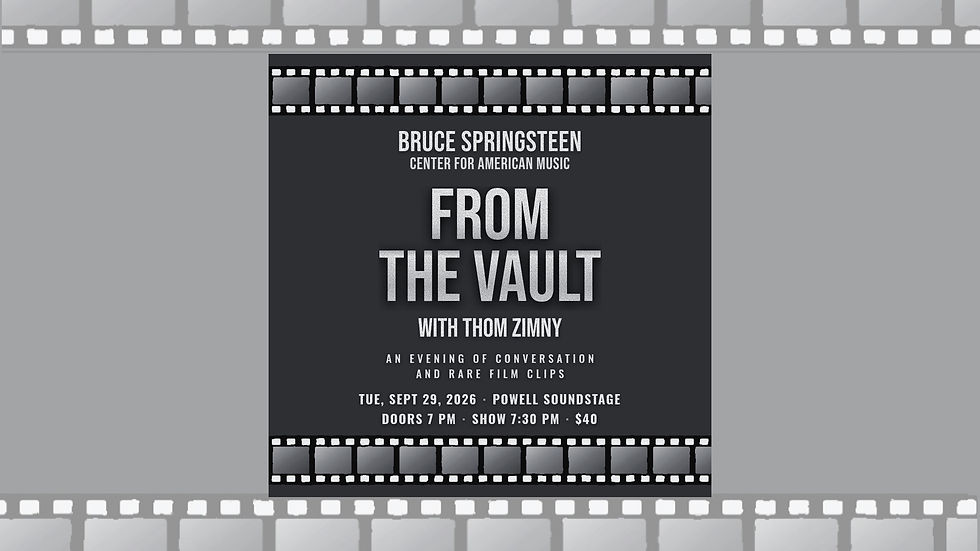
Mitchell also recently premiered Woody Guthrie and the Ghost of Tom Joad at The Woody Guthrie Center in Tulsa, OK, and has been invited to screen and talk about his film at The Bruce Springsteen Center for American Music. We'll have more information on the Springsteen Center's screening/speaking event once it becomes available. Stay tuned...