
As the Springsteen Center's doors begin to open officially, Part 1 of 3: the pre-opening concerts


June 12, 2026
As The Bruce Springsteen Center for American Music's official public opening occurs this weekend, Letters To You is presenting a three-part series of reports on the recent events that have led up to the big day. Here in Part 1, we cover the series of special concerts that the Center has held in anticipation of its public opening...
----------

May 29, 2026 - America 250: A Jersey Shore Celebration of the Nation's Music Heritage @ Pollak Theatre, Monmouth University - Lisa Iannucci reporting
It was a packed house for this concert, and expectations were high. The concert was the initial event of a celebratory week designed to precede the Springsteen Center's opening, originally scheduled for last Sunday, June 7 but then pushed back to this Saturday, June 13.
The two-hour concert was meant to explore the history and diversity of American music over the country’s 250 years, but this is not something that can really be done in two hours, or even in two concerts. The history of our music is vast and interconnected, with many roots, genres and sub-genres, and so much of it stems from marginalized, oppressed and enslaved communities whose only means of expression was vocalization. There are entire museums dedicated to the roots of this enormous and complex tree, and hopefully this event was just the beginning of a larger exploration.
The concert proceeded more or less chronologically, beginning with blues and folk, and moving on to roots rock, folk-rock, pop and radio friendly hits. Each artist performed a song related to the particular genre they were representing and then performed a selection of their own material, which was not really conducive to telling a story and brought too much focus upon the individual musicians rather than the material itself, which was supposed to be the star of the show. The result was a concert that felt disconnected and a bit scattershot, and unfortunately, the performances didn’t seem well-rehearsed in some instances.


Highlights included the great Sonny Kenn’s set with Vini Lopez and Reagan Richards, featuring performances of "Rocket 88" and "Johnny B. Goode," as well as Bobby Mahoney’s cover of Green Day’s seminal "American Idiot," but the loudest applause came for Shore stalwart Pat Guadagno’s performance of Bruce Springsteen’s "New York City Serenade," with Lopez and Richard Blackwell, both of whom performed on Springsteen's original recording. Ironically, Blackwell also was the only person of color onstage in a concert intended to explore an art-form as diverse as American music, even (or especially) from a Jersey Shore perspective.


The night ended with all performers onstage for shambolic versions of "Like a Rolling Stone" and "Rockin’ in the Free World," after which they lined up at the lip of the stage for applause and photos.
----------

June 3, 2026 - Native American Music Experience @ Pollak Theatre, Monmouth University - Shawn Poole reporting
You couldn't find a better example than this concert of just how comprehensive, inclusive, and history-spanning a definition of American music that The Bruce Springsteen Center for American Music is seeking to uphold. It was a great night, celebrating the many different styles of music made by the first people to call this landmass home, how it influenced and interacted with the music that followed it, and how it still does this in the present while heading into the future. Audience members got a stellar evening of entertainment, education, and inspiration... for FREE, to boot!

One of my personal highlights was seeing and hearing Julia Keefe's Mildred Bailey Project - Keefe's story of Mildred Bailey's friendship with and influence on Bing Crosby, as well as of her own great vocal prowess, was riveting in delivery and performance, concluding with Bailey's classic "Rockin' Chair." Then former U.S. Poet Laureate Joy Harjo joined Keefe's band for a beautifully fierce spoken-word jazz piece in which Harjo not only recited her poetry, but also played some wicked sax breaks!

Traditional Native American music mingled easily with rock, jazz, hip-hop, pop, folk, disco, country, and the blues throughout the evening, breaking down barriers while moving freely between the past, present, and future. And a strong Jersey connection could be found especially in the presence and performance of the great Felipe Rose, original member of The Village People and resident of Asbury Park for almost two decades now.


The show closed appropriately with a full-ensemble-and-audience singalong on Redbone's classic chart-topper "Come and Get Your Love," the first song by a Native American band to hit Billboard's Top Ten. Apparently, though they never performed or appeared onstage, Bruce Springsteen and Jackson Browne sat discreetly in the audience for this excellent evening of music and culture, which might explain how several of its performers ended up opening the Music America - Night 1 concert that followed it a day later. (Joy Harjo also received an invitation to compose and recite a poem about American music at the Springsteen Center's new-building dedication ceremony last Saturday, June 6.)
----------

June 4 & 5, 2026 - Music America: The Songs That Shaped Us (Nights One & Two) @ OceanFirst Bank Center, Monmouth University - Shawn Poole reporting
These were two nights of curated music performed by an ensemble of artists, most of them famous and major names in their particular genres, leading directly into the weekend during which The Bruce Springsteen Center for American Music's new building would be officially dedicated, have its ribbon-cutting ceremony, etc. Oh, and they took place in Monmouth University's arena that's used mainly for its sporting events, which is relatively small as arenas go, but still the largest venue yet in which any Springsteen Center musical event has ever taken place. Both nights of music were curated and narrated by Bob Santelli, the Springsteen Center's Executive Director.

Night One focused on pre-World-War-II music and Night Two focused on post-World-War-II music, with many highlights along the way. For Night One, there was the first set's sequence that launched with the Native American drum-circle and dancing, followed by Shemekia Copeland and Valerie June each beautifully singing Black spiritual and gospel music, Dropkick Murphys invoking the Irish balladry that helped give birth to American country music, and Keb Mo singing and playing the blues. It was a brilliant musical way to convey key songs of what is now known as the U.S.A. as having their roots in stolen land worked by stolen, brutally enslaved people and poor immigrants.


Bruce himself didn't appear onstage until well into the show's second set, where he would eventually perform with everyone else on the bill by the time the concert ended. First up was his beautiful, moving duet with Rosanne Cash on Woody Guthrie's "Deportee (Plane Wreck at Los Gatos)," followed by his uplifting duet/audience-sing-along with Kenny Chesney on Guthrie's "This Land Is Your Land," fully backed by Little Steven's awesome Disciples of Soul, once again providing stellar house-band services for a Springsteen Center musical event.


Then Bruce brought out Dropkick Murphys, joining them and the Disciples of Soul on an epic, rockin', and Celtic-infused double-shot of "I'm Shipping Up to Boston" and "American Land."

Finally, everybody returned to the stage, led by Trombone Shorty and the New Breed Brass Band, for an all-hands-on-deck, marching-in-the-aisles-around-the-entire-arena version of "When The Saints Go Marching In." Now THAT'S how you end a show about pre-World-War-II American music!


For the Night Two show focusing on post-World-War-II American music, we didn't have to wait long at all for Bruce Springsteen to pop up onstage. In fact, as soon as Bob Santelli finished telling us about the huge impact of Elvis Presley's mid-1950s rise to stardom, BANG! There was Bruce, back again and backed again by the Disciples of Soul, performing two of Presley's biggest hits, "Jailhouse Rock" and "Burning Love," with all of the enthusiasm and swagger that a lifelong Elvis acolyte like Bruce still can deliver in concert.


After Bruce left the stage to well-deserved applause, next up was a tribute to the late, great Chuck Berry, the 100th anniversary of whose birth will occur this October. (Santelli hinted at the Center planning something special for that upcoming anniversary.) Unfortunately, it started off more than a bit shakily with Jon Bon Jovi's rather pedestrian cover of Berry's immortal "Johnny B. Goode." (Don't worry; Bon Jovi delivered a much better performance later in the show. More on that below.) But then Stevie Van Zandt showed up to improve the tribute substantially by leading his own Disciples of Soul band in a fine version of Berry's 1960 musical sequel to the "Johnny B. Goode" story, "Bye Bye Johnny" (lines of which later got sampled by Springsteen in the 1980s for his bitter, mournful Elvis eulogy "Johnny Bye Bye.")

The first set continued with Sheryl Crow paying tribute to Patsy Cline's legacy, Gary Clark, Jr.'s paying tribute to electrified blues' legacy, and Dion DiMucci paying tribute to his own legacy, because like his fellow octogenarians who performed that night - Darlene Love and Mavis Staples - he's still in fine enough voice to do so, thank you very much. Sheryl Crow then returned to the stage for the show's two-songs segment on Bob Dylan, delivering a great version of Dylan's "A Hard Rain's A Gonna Fall," followed by Bruce joining her, along with past major Dylan collaborators (and married couple) Larry Campbell and Teresa Williams on "I Shall Be Released." (Campbell last performed with Springsteen as one of Bruce's two backing musicians - the other being Charlie Giordano - on Nebraska Live.)

Darlene Love then paid tribute to both herself and late, legendary (as well as infamous) producer Phil Spector, by singing a great version of "River Deep, Mountain High," the song that Spector cruelly refused to allow Love to record. Love's exultant performance closed out the show's first set, followed by an intermission. A similar show-structure also was in place on Night One, with an intermission placed between that show's two sets, as well. Kudos to Santelli and/or whomever was involved with building in the intermissions. While it probably helped the performers and crew at least somewhat with the flow of each evening, it definitely had its advantages for the audience, as a chance to catch one's breath for a bit after experiencing so much great music was welcome indeed.
The second set of Night Two opened with an exploration of jazz-fusion, with one of its pioneers also being one of the E Street Band's founding members: the great David Sancious, who performed as a duo with Living Colour's drummer Will Calhoun. (Click here to read Letters To You's February 2026 feature on Sancious' recent collaborations with both Calhoun and Italian musician Antonio Lusi, aka Lusi il Lupo.) After that, Jimmie Vaughan covered the Texas blues standard "Texas Flood," which his late brother Stevie Ray Vaughan recorded as the title track for his debut album. Then we were treated to Mavis Staples performing The Band's classic "The Weight" with the Disciples of Soul in a manner similar to the way that she and her fellow Staples Singers recorded the song with The Band in The Last Waltz's famous studio-filmed sequence, almost a half-century ago now.
Gary Clark, Jr. returned to helm the Jimi Hendrix segment of the evening, performing Hendrix's "Power to Love," aka "Power of Soul" from the Band of Gypsys album. Then Dion returned to launch the show's extended political/socially conscious segment, with a performance of his classic "Abraham, Martin, and John" leading into Jackson Browne performing his self-penned "For America" and - after inviting Stevie Van Zandt to join him - a version of Van Zandt's reggae-tinged "I Am A Patriot."

Bon Jovi was then back onstage, this time in much finer form, to join Nils Lofgren in a searing version of Neil Young's "Rockin' in the Free World," followed by Public Enemy performing an equally potent version of their hip-hop classic "Fight the Power."
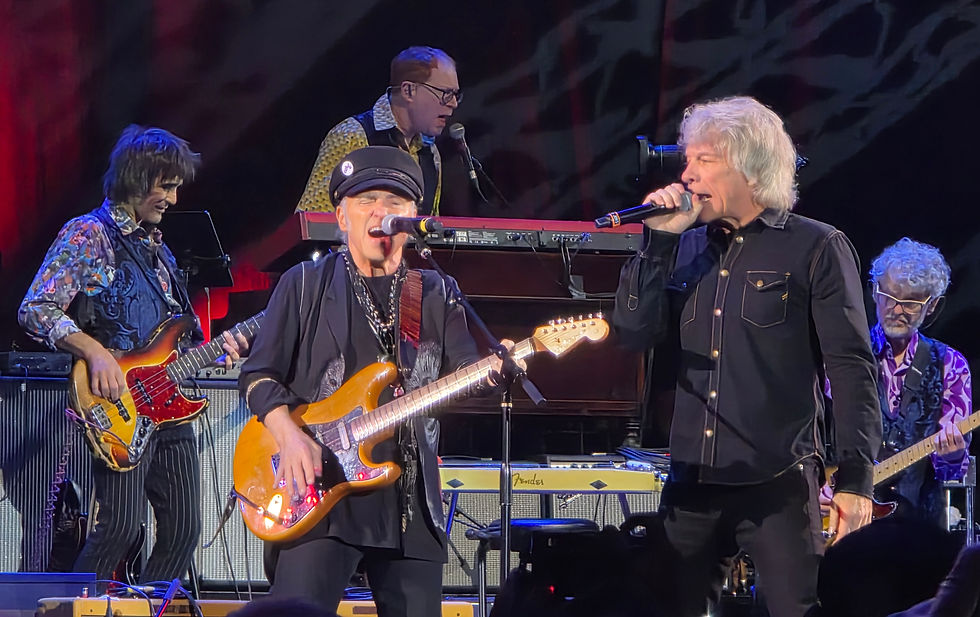
Springsteen then returned to the stage for the show's closing four-song set, but not without a hilarious bit of levity first. After Public Enemy had mistakenly - and repeatedly - exulted to the crowd that they were performing "Fight the Power" with "the E Street Band" instead of the Disciples of Soul, Bruce joked, "Wait’ll I tell The E Street Band they’ve been fuckin' fired. The E Street Band is gone now; this [gesturing to the Disciples of Soul behind him] is the new E Street Band... change of wardrobe and everything, man.”

Springsteen then dove heartily into a five-guitarist workout on the blues classic "Further On Up The Road" (not to be confused with Springsteen's own similarly titled song first released on The Rising,) joining with and playing off of Gary Clark, Jr., Nils Lofgren, Marc Ribler, and Jimmie Vaughan. That was followed by many, though by no means all, of the evening's artists returning to the stage (strangely accompanied by the unbilled and unacknowledged Grace Bowers, sporting both her guitar and her Ramones t-shirt) for the one-two Hey-we-are-in-New-Jersey-after-all punch of "Raise Your Hand" and "I Don't Want To Go Home."

Bruce then truly brought it all back home by closing with a beautifully sung solo-acoustic version of his own "Land of Hope and Dreams."

These two concerts, on the eve of its new building's official dedication, made it joyfully clear that The Bruce Springsteen Center for American Music intends to cover its subject as completely and in much detail as possible. Even two nights with over four hours of performances did not allow for every single significant American musical genre or figure to receive its due. (Bruce himself noted onstage near the end that Motown had been missed, quickly singing an a cappella bar of Smokey Robinson's written-for-The-Temptations "My Girl" to the mix.) Nevertheless, these concerts conveyed the scope and depth of what the Center hopes to cover with its new museum, archival, research, and educational spaces. Here's hoping that it will continue to offer experiences and insights as illuminating, inspiring, and enjoyable as these two shows were.


